Home »
Posts filed under turbo
Posted by Alex Bale
Thursday, February 7, 2013
Price as tested: €47,640+ Handling, performance, styling, seats, noise, fun– Hard ride, impractical= Small car, massive funThe back seats are missing. That’s the first thing you’ll notice when you climb aboard the (deep breath) Mini Cooper S John Cooper Works GP. It’s a limited edition Mini, with just 2,000 production examples for worldwide sale, and it’s been tweaked, tuned and body-kitted to within an inch of its tiny life.But as I say, the first thing you’ll notice is that the back seats have been binned. That’s both a weight-saving device (the GP weighs in at an impressively dainty 1,100kg) and it improves the handling, thanks to the massive red strut brace stretched across the space where the seats aren’t. It makes the body stiffer, which in turn makes the supension work more precisely which in turn... you get the idea.Under the bonnet which is under some fairly silly GP stickers and some fairly lovely (an unique to the model) Thunder Grey metallic paint, you’ll find the familiar 1.6-litre turbo petrol engine that has been powering the Mini Cooper S model since 2006. Clearly, for the GP it’s had some tweaks over and above the regular Cooper S and the previously range-topping Cooper S John Cooper Works model, with its 210bhp output. It gets an aluminium cylinder block and engine mounts, reinforced pistons and cylinder head, a low-weight crankshaft and even valves filled with sodium to improve their cooling efficiency. And all of that jiggery-pokery gives you... 218bhp. Hmmm. So not a massive improvement in power, then. But it must be a torque-monster, with that uprated twin-scroll turbo, right? Well, no. 260Nm of torque (280Nm on short-lived overboost) is about what you get from a 1.6 diesel Cooper D.This Mini is all adding up a bit oddly, isn’t it? The bodykit, and those gorgeous 17” alloys, seem to be writing profligate cheques that the engine simply can’t cash. And then you clock the time that this car set around the (FearsomeⓇ) Nurburgring race circuit in Germany. Now, normally, I regard Nurburgring times as just so much pointless genitalia-waving but the Mini GP’s time of 8.23 is seriously impressive, and with that relatively under-powered engine, means that the chassis must be doing something right.Unique coil-over-inverted-shock front suspension is the first step, combined with reduced front toe-in, a 20mm drop in ride height and 330mm front brakes grabbed by six-piston calipers. Understand any of that? No, me neither, but it sounds impressive.More impressive is the way it works on the road, and here again the Mini GP confounds expectations. With those deleted rear seats, the strut brace, the bodykit and the liquorice-strip tyres, you’ll be expecting a stripped-out, race-spec cabin. But no. Here there is climate control, an iPod connection, Bluetooth phone and a trip computer. Here too are lovely, leather-wrapped bucket seats that grip without squeeze and cosset without ache. This is... civilised. And that is surprisingly true of the whole car. Yes, it rides firmly and around town it bucks and skips over bumps in a highly irritating manner. But get it out onto the open road, and suddenly the ride settles down, and aside from an occasional tendency of those specially-designed 215/40 front tyres to tramline, it’s just so poised and well setup that it can take your breath away. The traction and stability control system can be set up to stop the car sliding out of control, but to do so without interrupting engine power, a bugbear of all keen drivers. The bodykit may look silly, but it cuts rear-end aerodynamic lift by a claimed 90%, so it keeps the GP planted to the road.The steering is just about perfectly weighted, and feed back a constant chatter of road surface data to your fingers. That long-held Mini trait of seemingly endless front-end grip is magnified here, so that the nose flicks into tight, fast corners with a tenacity that borders on the terrier-like. But it never, ever feels nervous. Even on a proper, bumpy, wet, puddle-and-mud strewn Irish back road, the Mini GP feels secure, sure footed and above all, fun. While it might be setup for the race track (and the suspension is fully adjustable for that if you have the time, tools and inclination) it is actually a supremely talented road car, able to devour favourite stretches in a madcap dash of fizzing revs and limpet-grip. And it can then settle down, quiet down and be a surprisingly comfy and capable motorway cruiser, or at least a far better one than the GT3-styling would have you believe.Downsides? Well, that lack of rear seats means that it’s either a two-seater with a massive boot or a seriously impractical van. The brakes which are so brilliant and reassuring on a fast run are irritatingly snatchy and sudden around town and it does cost €47,640. For a Mini. With no back seats.For all that, I’d be amazed if the GP doesn’t sell out, and fast. For a select few, those with the right roads on their doorstep and a love for the Mini brand, it is a brilliant little thing – all pumped-up aggression with a bass-line of usability. Yes, it’s both silly and over-priced, but then so are most Hollywood film stars, and the world would be a poorer place without them, too. It’s not quite the best hot hatch around (Renault Megane RS, step forward) but it is just terrific fun, missing seats and all.Facts & Figures Mini Cooper S John Cooper Works GPPrice as tested: €47,640Range price: €17,900 to €49,940Capacity: 1,598ccPower: 218bhpTorque: 260Nm Top speed: 230kmh 0-100kmh: 6.3secEconomy: 7.1l-100km (39.7mpg)CO2 emissions: 165g/kmVRT Band: D. €570 road taxEuro NCAP rating: 5-star adult, 3-star child, 2-star pedestrian
Posted by Alex Bale
Tuesday, February 5, 2013
Price as tested: €23,170
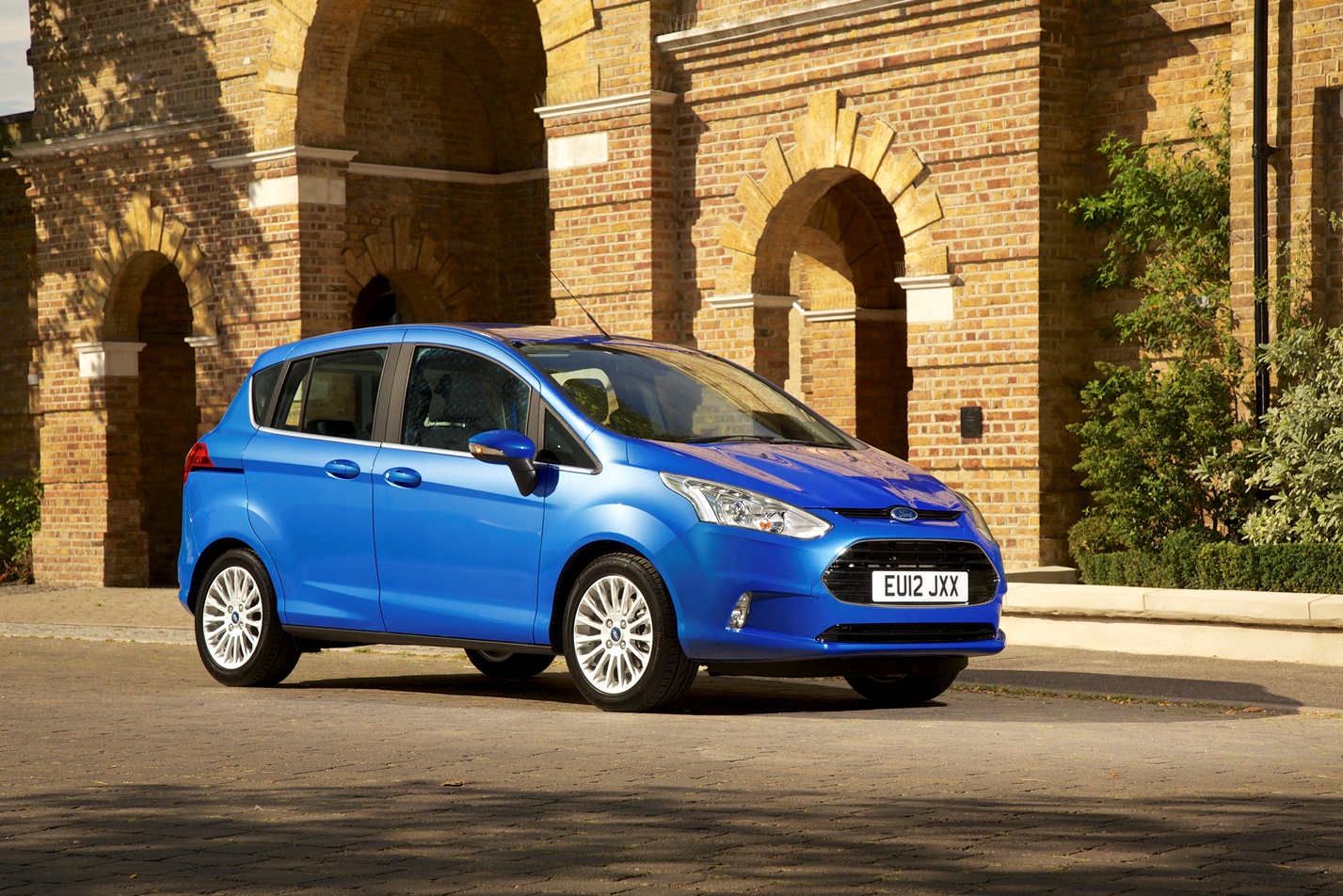
+ Doors, comfort, engine, chassis, quality– 1.0 not economical enough, needs more space in the back= Better than the diesel version but still flawedYou know what, I may have given the B-Max a bit of a harsh time the first go-round. When I first drove Ford’s clever new compact people carrier, I was disappointed by its lacklustre new 1.5 diesel engine and equally disappointed by a ride quality that was just too firm and handling that felt too top heavy.
And while my criticisms of the diesel and the ride remain, having spent a bit more time with this, the 1.0-litre turbo petrol EcoBoost model, I have to say that the B-Max is coming rather more into focus for me.
Let’s start with that engine, which has been showered with praise and awards since it was launched last year. Virtually small enough to fit into carry-on luggage, the little three-cylinder EcoBoost engine is a paragon of smoothness, refinement and, surprisingly, grunt. A 100bhp power output is plenty enough in a car the size of the B-Max, and while 170Nm of torque isn’t much compared to the best diesels, it’s enough to make sure that the B never feels sluggish or caught in the wrong gear. And then there’s the character of it. Quiet and hushed at a motorway cruise, it revs happily and emits a distinctly Porsche-esque growl as you approach maximum rpm. It is quite brilliant.
Or at least it would be if not for a significant achilles heel. Fuel consumption. There’s no way of getting around it, over a mixture of motorway, town and main road mileage, I averaged just 8.2-litres per 100km. That’s 34mpg. That’s simply not good enough for a compact family car these days, especially one so explicitly looking to tempt diesel buyers back to petrol. I know, I know, long motorway hauls aren’t a petrol B-Max’s natural metier, but all cars these days have to be all things to all people and the sad fact is that I’ve gotten similar average consumption out of a 218bhp Mini Cooper S Works GP...
That aside, the B-Max really is a lovely little car to drive. Perhaps it’s the reduced weight of the petrol engine versus the diesel that last I tried, but the handling felt distinctly better. You still feel that the weight of the body is set a touch too high (those complicated latches for the sliding side doors the culprit perhaps?) but it’s still got that lovely, fluid feel we’ve come to associate with Ford’s right back to the 1993 Mondeo. The ride quality is still a touch too firm I’d say, and that gives ground to the much more supple Citroen C3 Picasso, but if you’re a keen driver, who needs a small, practical family car, then this is the one for you.
That said, if you really need a small, practical family car, I’m not 100% convinced by the B-Max’s credentials in the practicality department. Those sliding side doors are brilliant, and they make the loading and unloading of small people and their car seats very easy, especially in the close confines of a multi-storey car park. The fact that there’s no b-pillar doesn’t really have a massive effect in terms of loading and unloading, and in fact for some people it may make getting in and out a little more tricky (nothing to grab hold of bar the front seatback) but on the whole, it’s an entertaining gimmick and would certainly make a trip to IKEA that much easier.
But there’s not quite enough space in the back seats, specifically in the legroom department. I’m a hair over six feet tall, and I can fit in the back reasonably comfortably. But my two-and-a-bit year old son, who’s a hair over three feet tall, struggled a bit with space. Why? Because there’s a full six or seven inches between the back of the base that his car safety seat sits on and the actual base of the seat where he sits. That means he’s lifted up and forward by the shape of the seat, which means either he’s cramped for legroom, or I am because I have to pull my seat forward to give him space. It’s not a problem unique to the B-Max, but given the amount of thought Ford has clearly put into the doors, I was hoping for better.
The rest of the interior is just about perfect though, with a big, deep, square boot, comfy seats and a lovely-looking, high quality dash. My Titanium-spec press car also came with Ford’s new Sync system that connects wirelessly to your smartphone both as a phone and as a music player. As a phone it worked swiftly and flawlessly, but I found that the Bluetooth audio streaming tended to make tracks skip annoyingly, but they did play smoothly when connected by a USB cable. Still, the sound quality of the optional Sony stereo was little short of awesome. A highly recommended option.
At €23,170 for the test car, the B-Max makes an interesting alternative to a conventional hatchback, and its extra height and trick doors means that it’s potentially more practical than a similarly priced Focus. But that (otherwise) brilliant little 1.0-litre engine needs to give better economy in real world driving, and a touch more space in the back would make the B-Max nigh-on unbeatable.
Facts & Figures
Ford B-Max 1.0-litre EcoBoost Titanium
Price as tested: €23,170
Range price: €19,821 to €27,600
Capacity: 999cc
Power: 100bhp
Torque: 169Nm
Top speed: 175kmh
0-100kmh: 13.2sec
Economy: 4.9l-100km (60mpg)
CO2 emissions: 112g/km
VRT Band: A4. €200 road tax
Euro NCAP rating: 5-star; 92% adult, 84% child, 67% pedestrian, 71% safety assist – joint safest car in small MPV category.
Posted by Alex Bale
Wednesday, January 23, 2013
Price as tested: €36,800
+ Massive grunt, lairy soundtrack, chassis, solid build, practicality- Styling doesn't look premium enough inside or out, not well enough equipped= Ford's working class hero for the 21st Century rekindles old Cosworth romance
Like so many of my age group, I grew up on fast Fords. My first motoring memory is of standing on a ditch, somewhere near the village of Ballydehob, where my dad had taken me to see a stage of the West Cork Rally. Now, my dad's a football nut, not a car nut but he still seemed excited to be there, and as a curious six year old, I wondered why. Then I saw, for the first time ever, Billy Coleman gunning, slipping and opposite-locking a MkII Escort between the hedges, BDA engine burping, farting and snorting away like a cage of warthogs with IBS. I wondered no more.
If by then the MkII was already something of a dinosaur, then I didn't have to wait long for more iconic hot Fords to come along and trawl for my desire. First came the XR3i, then the short-lived RS200, then the mighty first generation Sierra Cosworth. By the time I came to driving age, I was fully convinced that a Sierra Sapphire Cosworth 4x4 was the ideal and perfect car for me. Sadly, in lieu of a Lotto win, I was relying on my dad's generosity of spirit and he duly let me learn how to drive in his Sierra. A hatchback LX with the 1.6-litre engine. I think it had about 12bhp...
Still, by the time I passed my test there was the Escort Cosworth to lust over and then... And then there wasn't much at all. The Escort Cossie was the apogee of the hot hatch, a car which cost more to insure than it did to buy and for a time, Ford more or less entirely retreated from the affordable hot car market. A few trickles came along, such a the Mk1 Focus ST (sweet chassis but not actually much more fun than a diesel 1.8 TDCI) and a few ST Mondeos, but it too until 2003 and the arrival of the Mk1 Focus RS to really kick-start the fast Ford revival. Since then, we've had an even more extreme (properly Porsche-quick) Mk2 Focus RS and a warbling, five-pot ST (lovely but too thirsty by half). And now this, the Mk3 Focus in ST spec, with a new 2.0-litre 250bhp four-cylinder turbo EcoBoost engine. It's a five-door only model (in direct contrast to most previous Ford hot hatches, although there is a rather anti-cool estate version) and seeks to finally bridge the gap between previous lairy and uncouth performance Ford models and the more sophisticated likes of the Volkswagen Golf GTI.
First off, the ST's looks are a little odd. In spite of big wheels and a chunky bodykit, there is little to tell the unassuming bystander that this is a performance flagship. Yes, there's the gaping, Aston-Martin-esque grille, but you can now find something similar on a boggo Fiesta, so that's hardly a telling item. No, this Focus, for the first time in hot Ford history since that long-desired Sierra Sapphire Cossie, majors on subtle looks.
That's true of the interior where the overwhwelming impression is that of standard Focus. Yes, there's an extra bank of dials atop the dash, the steering wheel and seats have bold ST logos and there's a plaque on the centre console indicating your car's build number, but other than that it looks stock. Beware of the seats, incidentally. They look gorgeous but the bolsters and supports are so chunky that if you're built along similarly husky dimensions to myself, you may find them restrictively tight. Better lay off the cupcakes. (It also feels curiously bare. Not cruise control? No heated windscreen? On a €35k car? Really?)
And when you first fire up the powerful new engine and pull out onto the road, you may also feel a slight lack of being whelmed. Unlike previous fast Fords, there's little sense of urgency or hairy-chestedness, assuming that is that you tickle it along and upshift early, as we've all become accustomed to doing from driving tourquey, low-revving diesels. The ride is certainly firm and thumps hard over sharp obstacles, but mostly, it's just refined and easygoing, with a hint of muscularity underneath.
And then you drop a gear and venture beyond 3,000rpm and all hell breaks loose with a side order of demons. Then the engine shows is true colours and they are fully red (shade: tooth & claw). It emits a hard but tuneful bark that swiftly becomes addictive. It's not the musical roar of a big V12 or the grumble of a V8 but a blunt, business-like shout that speaks of racing heritage and serious intent. That seriousness is hammered home by the fact that the traction control light has by now more than likely become constantly lit and the steering is bucking in your hands as the front tyres try to choose between being traction devices or simply smoke emitters. It is, just a bit, exciting.
But curiously, not OTT. Yes, the torque steer is there, as mentioned, but a firm grip on the wheel easily quells it. And yes, there's wheelspin there for the taking, but the odd thing is that the Focus ST feels like a duck. You know that old adage about a duck swimming on a lake looking serene and effortless on the surface while underneath it's paddling like hell? That's what I mean. If it can be said that the Focus ST has a split personality, then it's split along the horizontal axis, all thunder and fury down below, while you sit calmly atop, deciding the precise degree of fury to unleash.
The handling is just excellent. Yes, it would be nice for Irish conditions if the ride had a touch more pliancy, but the way the meaty steering pulls you into corners and spits you, cannon-shell-like, out the far side is a truly terrific experience. In some ways, with that wheelspin never far away and the sledgehammer power output, you could see the Focus ST as a bit of a crude weapon, all point-and-squirt. But learn to hold back the throttle a touch to keep the wheelspin quelled, learn to lean on the grip of the front end and realise that the engine, far from being peaky or laggy, actually does a convincing impression of being a much larger, naturally-aspirated unit, and you will unlock the immense point-to-point ability of the ST.
And that, in a heartbeat, finally bridges the gap between a fast Ford and a supposedly more sophisticated Golf GTI. Yes, the VW badge will continue to carry more kudos and apparent classiness, and the Focus isn't helping its own cause by persisting with a cabin that still feels a salary band lower than that of the Golf (even if its actual quality is unimpeachable) but here at last is a Ford hot hatch that works equally well as a daily driver and a Sunday morning cobweb remover.
Any car that can sprint from standstill to 100kmh in 6.5secs and on to a top speed of almost 250kmh has to be considered as a serious performance player. But any car that can seat for in easy comfort, has a big boot and can manage 9.0-litres per 100km (31mpg) can also be safely considered for family use. Drive with a modicum of sense (and a low-carb diet to make sure you fit into the seats) and none of your passengers would guess that this Ford has the potential to smoke high-end German sports saloons on the right road. Equally, drive it the way it was designed to be driven and hear its aggressive bark, and you'd be hard-pressed to guess that it's a practical family hauler.
It hasn't quite supplanted the childish desire in my heart for a Sierra Cosworth, but as a more caring, sharing, efficient and (let's face it) faster modern alternative, I guess I can make space for an ST poster on my 12-year-old self's bedroom wall.
Facts & FiguresFord Focus ST
Price as tested: €36,800Range price: €20,315 to €39,100Capacity: 1,997cc
Power: 250bhp
Torque: 360Nm
Top speed: 248kmh
0-100kmh: 6.5sec
Economy: 7.2l-100km (39mpg)
CO2 emissions: 169g/km
VRT Band: D. €570 road tax
Euro NCAP rating: 5-star; 92% adult, 82% child, 72% pedestrian, 71% safety assist
Posted by Alex Bale
Tuesday, January 22, 2013
To say that Le Mans is magical is to grossly undersell it. While F1 becomes ever more tiresome, ever more mired in politics and ever more dull, the 24hrs of Le Mans remains as a true beacon of motorsports greatness. It’s a combination of motor race, camping, funfair, acid trip (especially at 3am) and group experience. It’s the ultimate, and has been since 1923.
And yet, in all that long and glorious history, from the Bentley Boys to the roaring GT40s to the unstoppable Porsches to the silent Audis and Peugeots, only one Japanese car maker has triumphed in an outright win at Le Mans. Toyota has tried (and will have another crack in 2013 with its fabulous TS030 hybrid), Nissan tried, Honda dabbled but only Mazda succeeded.
Through a combination of sharp driving skills, clever manipulation of the rules and keeping their heads when all about were being lost, Mazda brought the remarkable 787B, with its eerie, howling triple-rotor rotary engine, home first in the 1991 Le Mans. And hasn’t been back since...
That could be all about to change, and we’ll get to that in a minute, but first, we took the opportunity of this remarkable 20th anniversary to talk to Irish racing legend David Kennedy, who was a lynchpin of the Mazda team in 1991.“I was in several different motorsports businesses at the time and virtually knew every race driver as they were coming through. So I was well positioned to try and grab the next superstars coming through and bring them to the Mazda operation, after I’d driven with Mazda in the C2 category in the early eighties. So with my colleague Peirre Donaire, we were effectively the European arm of Mazda Motorsport.
“So we got hold of Nigel Stroud, who had been a designer at Porsche, and had had a hand in the dominant 956 racer, and had unique experience in building cars from aluminium honeycomb.
“The other cornerstone of the operation was a guy called Kio, who had been my mechanic in Formula 3, and between them they both bridged the gap in communication and culture between Japan and Europe, which was quite significant.”
To call Mazda the underdog in 1991 would be to lapse into understatement. Here was a small Japanese car maker, with a new car, a new team and a rotary engine going up against Porsche, Mercedes, Peugeot and Jaguar at the most storied race event in the world. How the hell did they pull it off?
“These cars were 800bhp, 230mph projectiles, they were fantastic to drive and unbelieveable to see, hurtling down the Mulsanne at 230mph, slipstreaming each other.
“But we were a very tight, very cost-effective organisation. A pure motor racing group, where as some of the other teams were maybe manufacturer heavy.
“As for the engine, the rotary was unique, and it had its advantages and disadvantages. One of the disadvantages, it never gave you engine braking, so at the end of the Mulsanne, there was no help. But we managed to get carbon brakes on the car, so then it was a benefit because no engine braking means better fuel consumption. And because it was so smooth, it was like riding a magic carpet, and very good in the wet, with very progressive power. It felt like it would go on for ever.
“Against the turbos, they would accelerate off the corner faster, but you’d catch them at the end of the straight.”
Still though, up against the might of Mercedes (with a certain Michael Schumacher in one of their cars) and multiple winners Jaguar and Porsche, and even home favourites Peugeot with the new 905 racer (which would win in 1992), Mazda looked to be an also-ran.
But there was a secret weapon. Weight.
Because of the compact, light rotary and thanks to come clever chasssis design, the 787B was actually running in a slightly different rule class to its rivals, meaning it could carry around 150kg less weight. A crucial factor. As was the main Mazda driver trio of Johnny Herbert, Bertrand Gachot and Volker Weidler. Despite both Herbert and Weidler still recovering from massive F3000 accidents, all three drove magnificently.
And as the Porsche, Mercedes and Jaguar challeneges faded all around them, the shocking-looking (that wild orange and green paint job), shocking sounding (David relates that he couldn’t sleep inbetween his driving stints because he kept listening to the distinctive rotary engine wail, heard above all the other engine noises. Herbert says much the same.) 787B worked its way up steadily through the field until, with just a few hours left, the leading Mercedes, driven by Jo Schlesser, Jochen Mass and Alain Ferte, pitted with an overheating engine, and suddenly car no. 55 was in the lead.
Famously, Johnny Herbert’s final to-the-flag two hour stint in the baking hot cockpit pretty much finished him off. He brought the car home to the chequered flag, then promply collapsed from heat exhaustion, leaving Gachot and Weidler to take to the top step of the podium without their comrade.
“There was a Japanese report done by Mazda, and as ever Japanese reports aren’t small” says Kennedy. “It was of biblical proportions, on the reasons why we had won. And on the last page it said, ‘maybe it was because the car was blessed by a Bhuddist monk at the foothills of the snow-capped Mt Fuji.’ I was there for that blessing, it was a fabulous ceremony. And sometimes you scractch your head and say who knows?”
Twenty years is a very, very long time in motor racing. For half of that time, Audi has utterly dominated at Le Mans with its mighty diesel cars, and Peugeot has only been recently able to offer it stiff opposition. But now, Jaguar, Porsche, Toyota, Bentley and others are looking at reviving their Le Mans campaigns. What of Mazda?
Well, David attended the recent 20th anniversary celebrations, which saw the 787B return to Le Mans for an emotional ceremony, one which was thronged with crowds. “You know what, I think a lot of the Mazda guys clicked that there’s something they’re missing out on.”
So there’s hope then. Hope that the Mulsanne, Arnage and Tetre Rouge will once again vibrate to a banshee rotary wail.
Posted by Alex Bale
Friday, January 11, 2013
There hasn't been a high-performance Passat since the slightly nutty W8 engined version went out of production close to a decade ago, but it seems that VW is now intent on producing a more sporty version of its four-door saloon, at least for the US market.
It may not look like much on the outside, but this is the Passat Performance Concept, bound for the Detroit Motor Show next week and you can pretty much forget the concept bit and assume that this very car will go into production for the US, and just possibly Europe, next year.
There's not many giveaways on the outside; even those ritzy 19" wheels look quite subtle, but underneath this Passat is packing lower, stiffer suspension and VW's EA888 2.0-litree turbo petrol engine cranked up to a hefty 247bhp.
Apparently the interior has been suitably gussied up too, with carbon and leather trim elements. Will such a Passat make it to Europe? Well, the market for hot saloons is pretty tiny, but given VW's sprawling interests and profit margins, they might just decide to do it for a laugh...